Thursday, August 9, 2012

Everything's Gonna Be All "Right"

(Aug 7)

The intensity of our training at the Dagbe Center hasn't wained as we find ourselves ensconced in the second week of our learning.  If anything, it has intensified.  The instructors work us hard in morning dance class, but we know it's gonna be alright when we see one of the staff with a machete and a pile of coconuts. :-)


Next Monday we will perform for the community.  We just started working out the detail of our performance. There are a number in our group who have taken on the task of learning the master drum part for one of the pieces, Gahu, and so the plan is have them rotate through the variations of master drummer's part. The rest of us are still determining our roles with the help of our instructors.

I can't speak for others, but I am apprehensive about performing.  The pieces have either an extended form, or proper execution of the form of the piece involves paying careful and vigilant attention to the master drummer, who shapes the piece according to his or her inclination.  In rehearsals, mistakes are commonplace, Almost no one in our group can play or dance a piece from start to finish without making at least a few mistakes.  Yet, we are proceeding on the assumption that everything will be alright. 

As you can guess, there is a social piece of the course's curriculum.  Most of us have never been able to observe and interact at such close quarters with a culture as divergent from our own.  Adults in Kopeyia casually treat us as if we are part of the community, and we are comfortably at home when we are in the village. In the evening, we often walk through the village to a hut that we have foundly come to call "The Empty Cup" where we can relax among the locals.  The other night, our "academically motivated" interest was peaked when we observed one of the surprisingly flavorful local favorites being decanted from a gas can! I am hoping to bring back a bottle; more research is needed in this area. Indeed, everything will be alright.

There are a number of local and regional customs that we were made aware of at the outset of our travels in Ghana.  Lack of attention to some of them can result in an awkward moment.  Luckily, because we can be quite easily identified as tourists so people cut us lot of slack.  Nonetheless, we try to be ever-vigilant and respect local customs.  One that is particularly difficult for me to comply with is the practice of using only the right hand for any transaction or personal interaction -- even waving.  Everything's gotta be ALL RIGHT.  The left hand is considered to be "dirty."  Unfortunately, I was afflicted with a case of terminal left-handedness as a small child -- yet I somehow learned to use scissors and write without smudging -- so I have been determined to meet this challenge. I have even developed a few tricks, like holding things in my left hand to prevent those dirty little outbursts, but the occasional faux pax still breaks through.  Fortunately, Jeremy has instructed me in the delicate art of how to appropriately apologize for the inadvertent transgression. Yes, even when I forget to use my right hand, even when we're struggling to learn our drum parts, and even when we get turned around in the dance, we know... EVERYTHING'S GONNA BE ALRIGHT!

-Mark

I blog with BE Write

Wednesday, August 8, 2012

A New Dance

Aug 7

Today we began to learn a new performance piece, starting with the dance in the morning.  The Atsiagbekor commemorates the story of a village that prepared for, and then successfully defended themselves against attack from a well-known warrior tribe. Each part of the highly stylized dance represents an event in the story.


The Atsiagbekor dance style strongly contrasts with the Gahu, which we learned all last week. Gahu, which translates to "money drum," originated in Nigeria, and is, for lack of a better descriptive, party music. We were constantly reminded to smile while we danced it.  Of course, the Atsiagbekor has a much more serious theme, and the dancers must express its sentiment in all parts of their body. -- We even get to use props in this dance, and my favorite is the sword!

Laura here. In afternoon, we continued our studies of Atsiagbekor in drum class. I find the experience of learning new drum parts fascinating. All of our teachers verbalize the patterns "pah-ti, pah-pah, pah-ti, pah-ti, pah-ti, pah-pah." Later that day I was spending time with a few of the village children and I showed them a video from dance class this morning. They were singing along with the drum parts... it was very melodic (and cute.) 


Singing the parts in my head (inner hearing), is critical to my success in the ensemble. In any Ewe piece there many rhythms happening simultaneously.  When I first started learning, the wash of contrasting rhythms overwhelmed me. I frequently crossed the parts in my head and struggled to hold onto my assigned rhythm.  Now, after a week of immersion in the music, I am able to pick up my part more easily. I'm also becoming more adept at opening my ears and hearing a part in the context of the other rhythms... this phenomenon is a remarkable experience that is difficult to put into words. Even more amazing... I find myself now able to "sing" more than one contrasting rhythm in my head while playing another.  This is something I've been doing with harmony for years.  I'm experiencing rhythm like I never have before... Mark and I often share discoveries like these as we explore this multi-faceted and extraordinarily rich medium of expression.  We are already excited about seeing these realizations bear fruit in our classrooms.

Thanks for reading,

-Mark and Laura

I blog with BE Write

Tuesday, August 7, 2012

Song & Praise

(Aug 5)

This morning we gathered under the summer hut to meet Mensah, during who took a group of us to his church.  He prepared us for what to expect in the service, and after a very short walk we were there.

The church is a partially built structure... four half-built brick walls, a dirt floor, a tin roof supported by temporary wood planks, a modest altar covered with lace cloth, and two columns of wooden benches for pews. The women and men sat on separate sides. Despite its very modest appearance the people made it a warm and welcoming place.

Before every service, there is Sunday school. Mensah translated during the lesson, which was about how Christians should live lives full of love for others. As the Sunday school lesson closed, people began to slowly fill the church.  The bold patterns and bright colors of traditional Ghanian dress transformed the shell of this church into a vibrant place of worship. Women wore beautifully tailored dresses and lovely scraves, while the men wore dress shirts featuring similar patterns. 


Most of the two hour service was filled with music. An improvised version of Western hymn tradition, blended seamlessly with elements Ewe rhythm and dance. During one song, many of the women came up and danced Agbadza. Once they returned to their places in the pews, a number of men, including two brave souls from our group, took their turn dancing. There were drums, and many of the women, even a few of the cute little girls, had tambourines.  The worship was filled with joy.

Naturally, there were several times of prayer; however, only one period of silent personal prayer. Frequently the congregation would follow a song with a time of prayer in which everyone prayed out loud at once... It was a lot to take in given my lack of exposure to Pentecostal traditions. In the middle of the worship we were invited up front where we presented an offering we had collected as a group. Mark and I lead our group in "When the Saints Go Marching In," which the congregation loved.

The sermon was on a parable from the book of Mark, chapter four. They read the scripture in both Ewe and English. One of the elders translated the sermon for us... clearly we were honored guests.  At the end of the service we were invited up to the front again and the entire congregation prayed for us during another time of communal prayer out loud... it was quite humbling. We were encouraged by the pastor to continue to think of this community as we return to the states. Worshiping in this humble setting challenged me to reflect on how fortunate most American congregations are; however, it isn't the building that makes a church...  it is the community and in this regard this congregation is indeed rich.

Thanks for reading,

 Laura

I blog with BE Write

A Celebration of Life

(Aug 4)

Today we were fortunate enough to be invited to a funeral in Dzogbedzi, one of the the villages adjacent to Kopeyia.   Yes, I (Mark) know it sounds like an odd thing to say 'fortunate,' but a funeral in Ghana more resembles a wedding in the U.S.  It is truly a celebration of life, and the opportunity to go to one should not be passed up. 
This particular event lasted for almost two days, and the music was non-stop.  We heard drumming from the distance the entire night prior to our visit.  The music ranged from traditional Ewe (the regional name of the people, as well as the name of the music we are learning), to a more techno-African style of music.

To hold a proper funeral ceremony, it is common practice for a village to spend a large amount of community funds to rent things like a portable sound system and tents, and so it has become a custom that anyone who is not a member of the village is welcome to participate... after making a donation. 

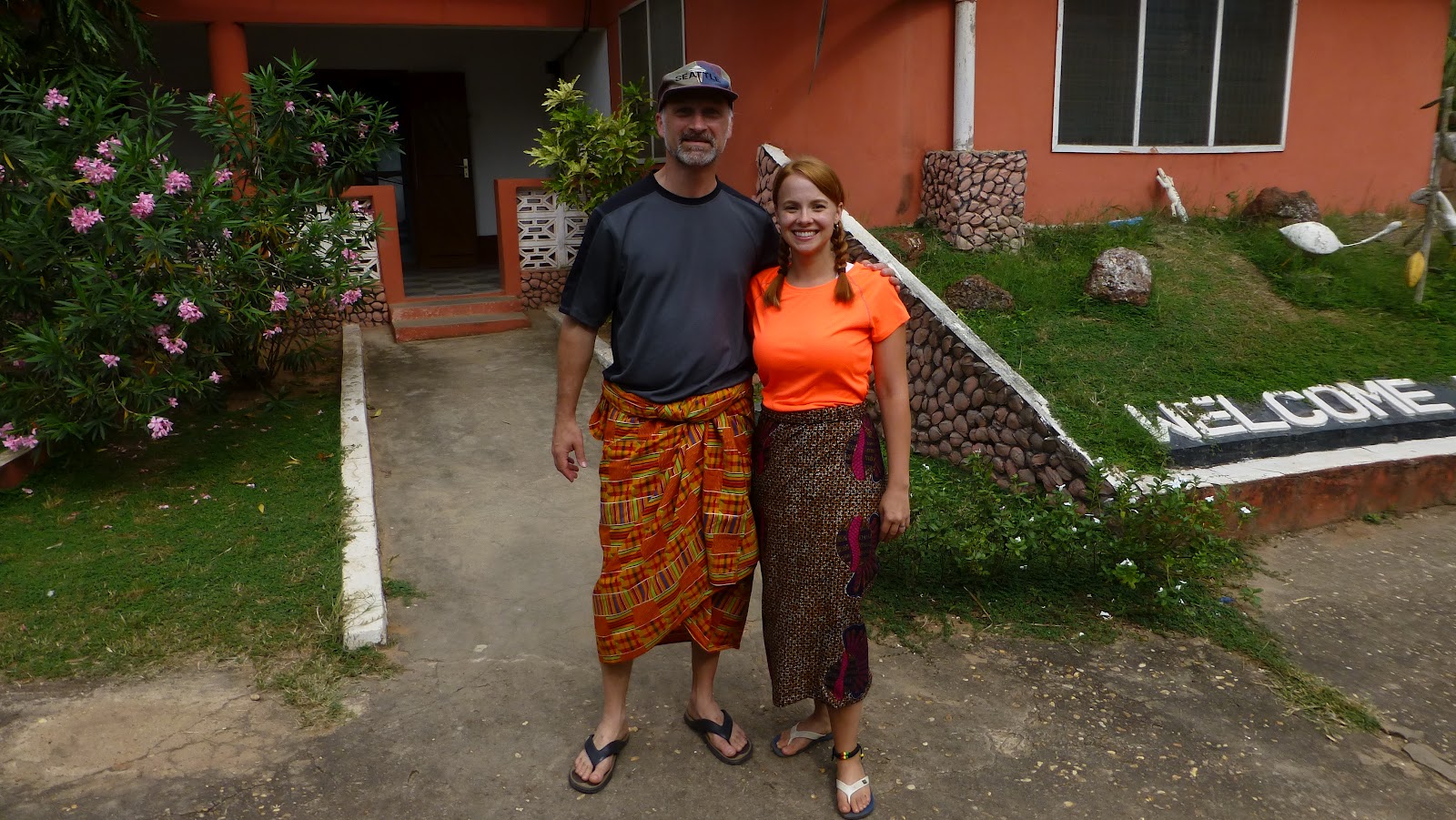
We were fitted in appropriate garb and walked no more than 5 minutes to the next village.


Picture: The front entrance to our "dormatory."

As we arrived, there were hundreds of people were dancing.  The two bands that were simutaneously playing could not have been much more 50 yards apart, yet there's something about Ewe music that allows for this to not be a problem.  It may be because of the density of the rhythms, or perhaps it's the volume of the axhatche or the wooden clapping instruments that many of the women played, but I can assure you that as a dancer, it is only possible to focus on one band at a time.

We were forewarned that people would ask us to dance, and so our dance instructors taught us how to dance the Agbadza, a very necessary skill to have at a funeral or any Ghanaian social gathering.  At first sight, the dance seems simple and repetative, but it's a good thing we had been working on a number of elements of Ewe dance since we arrived in Kopeyia; executing the subtleties of the Agbadza elegantly and musically does not come easily. Our preparations paid off; it seems anything we do to demonstrate our interest and appreciation of Ghanaian culture is well received.

As we began to mingle with the crowd, I tried to position myself in an area that seemed good for observing (and safe from dancing), but to no avail.  A number of women approached me with the proscribed opening pre-dance moves -- so much for my strategy of avoidance. At one point, upon seeing that I knew the Agbadza (or could at least move in a way that resembled the dance), another woman coaxed her daughter who could not have been of more that 8 years to walk over and initiate a dance with me.


Photo by Robby Bowen

We stayed for almost two hours and everyone in our group danced. Once again, I found myself lost in the swirl of colors, smells and rhythms.  A picture -- or even a video could never do justice in describing its kaleidoscopic effect on the senses, nor the overall gestalt of the experience.

Weather Report: Since our arrival in Ghana the weather has been mostly overcast with a light breeze.  The Sun is always struggling to cut through the clouds.  Low and high daily temperatures seem to consistently fall between 75 and 80.  In short, the weather has been absolutely perfect considering the demands of our schedule and my ever-sensitive hairless head.

Last night, the sky became mostly clear for the first time.  The constellation Scorpius was much higher in the sky than I've ever seen, and I was able to enjoy the patch of sky named Aquarius in its entirety for the first time ever.

Tomorrow, we begin a full week of scheduled classes.  Must get sleep. Must get ... mmm...  zzzzzz..

-Mark

I blog with BE Write

Saturday, August 4, 2012

Weaving Through the Marketplace.

(Aug, 3)

In the afternoon today most of us took a trip to the marketplace.  We were advised to only take pictures with consent, so it's difficult if not impossible to take a photo of a larger section of the market... but I did mange to sneak in this shot.


The entire marketplace takes up what feels like 5 or 6 acres of tightly knit stalls along dirt paths that barely permit two people moving in opposite directions to pass one another.  Not a square foot is wasted.  Some venders have stalls, but others who only have a few smaller items or produce to sell have carefully embedded themselves in nooks along the paths.  It is hard to imagine what it would be like if there were more people.  If not for the fact that all of the women porters carry commodities on their heads, things would surely come to a standstill.

The place is a sea of constantly changing colors, sounds, and smells.  Most all of the women wear brightly colored batik fabric or dresses with large bold prints.  A solid colored dress is a rare sight.  The main dirt road that defines one of the boundaries of the marketplace is lined with stalls as well.  This road is packed with cars and people.. almost as densely as the paths between the stalls in the market place.  Right of way is determined by an entertaining mix of convention and the occasional game of chicken. We were lucky to have George and Ahtu guiding us.

The marketplace swings into action every four days. It is definitely not designed as a tourist destination; it's more like a farmers market/Walmart for the local people.  There is a somewhat open area in the center of the market where fish mongers (all of whom are women) have set up shop.  Most all of the seafood is dried whole fish, and the smell is concentrated...

Laura here. It was smelly all right! I asked George and Ahtu if they liked the fish and they said they loved it... to each their own. While I enjoy shopping, this was shopping on steriods... major sensory overload. Luckily my group was on hand to help me stift through the pleaortha of options amongst the many fabric shops. Suprisingly, Mark found the golden ticket, a beautiful green fabric with a lovely print that will become a new dress. After the market, we went to the tailor in the Kopeyia. I drew a picture of the dress style I wanted for him and he took the necessary measurements. I'm so excited to get my tailor-made dress. :-) 

Thanks for reading!

Laura & Mark

I blog with BE Write

It's a Groove Thing

(Aug 2)

The ante was raised in drumming class.  The instructors are letting us choose to review or move on to more complicated parts.  Laura and I elected to move on, and we are both struggling a bit to keep up with the pace of class, which is moving at a speed that is more appropriate for the 5 percussionists in our group, however the teachers help us hold our own. The music is dense, intense, and complex, and it is also starting to tax our technical abilities.

We are all encouraged to take private lessons.  The Dagbe Center is a very important part of the economy of the Kopeyia community, and so teaching there is a coveted job.   With the current Dollar to Cedis conversion rate, a one hour lesson runs around $8.50. 

Today, Laura, Valerie, a professor of Music Education at University of Laval in Quebec City, and I took a private drumming lesson where we started learning "Tokoe."

None of us are hot shots, and our instructor, Mensa, is very patient (he teaches kindergarten at the local school.) Needless to say, the class moved at a more friendly pace. Being a good teacher, Mensa also assigned us homework for next time we meet.


Though it is physically demanding, dance class is a blast.  I (Mark) feel like I can move properly, but transitions are very hard to hear because the musical cues, sent at the whim of the master drummer, are often subtly embedded in a swirl of the music. With West African music, the "beat" is put in the dancers' feet. The contrasting "rhythms" are played by the musicians on various instruments.  These rhythms all seem to originate at unusual (and hard to get to) places. 

Before dinner a group of the girls visited the local tailor. Tomorrow we're going to go to the market tomorrow to buy fabric. I (Laura) plan on having a dress made. The tailor's shop is a circular hut made of cement with a thatch roof. He uses a coal iron and a beautiful old-fashion sewing machine.

Later in the day, Paul, one of our teachers whose uncle is the tailor, took us on a walk through the village. We were a small group, so it was a more intimate look into village life. Paul showed us his place and we ran into several of our teachers at their homes. We observed village life, boiling an egg for lunch over a small fire, a new born baby goat taking his first steps, kids cooking, women pulling water from a well. It was wonderful!

This evening I continued my private dance lessons. I was working with George, who is a very talented musician and dancer...  and goodness, he can play the master drum LOUD! Now that private lessons are started it can be challenging to find a place that is removed from all the music other people are playing. George, two other dancers, and myself found a quieter place at the front of the center. A solitary lightbulb added to the pale moonlight that kept trying to peak through the floating clouds..  it was a very "I'm in Ghana moment." We're both so thankful to be here. Thanks Derby Academy and Jeremy for making this fabulous experience possible

It was wonderful to have a closer look at daily life.

Cheers,

Laura & Mark

I blog with BE Write

Beat and Form

(Aug 1)

Today marks the first full day of our formal studies at Kopeyia.  With just a few exceptions, each day will scheduled similarly: breakfast at 8, dance class from 9-11, lunch at 12, free time after lunch (private lessons, exploring the village, rest, etc), drumming class from 4-6 followed by dinner.  Both dance and drum class are physically demanding, and Jeremy is constantly reminding us to hydrate. Since our arrival we have been encouraged to drink 3 to 5 liters of bottled water every day. Speaking of which.

There is no running water in Kopeyia; the center has a water capturing system that collects rain water for the showers and toilets.  Most water is  drawn and carried by hand from wells in the village. We try to "be kind" with how we use water. 


I (Laura) would describe the accommodations at Dagbe as a super deluxe camping... without camp fires or smores. So according Mark, this can't be camping without smores, but you get the idea.

During our free time after lunch and then again after dinner, we can take private lessons with the instructors.  In addition to dancing and drumming, we can study singing, weaving, cooking, tie-dying and batik making. Other than that, our time is our own, but there is course related reading to do, laundry to clean, and don't forget blogging.  Today I (Mark) took a "group" Djembe course.  There were five of us and they worked our hands to the bone.  One of the percussion majors in our class was playing so hard he split his hand open, quickly ran and got a bandage and wrapped it up, and was back playing within a few minutes.  Talk about dedication! 

This evening, I (Laura) joined up with two of the dancers on the trip for a private dance lesson. We worked on the "Tokoe," and I must say I didn't do too bad for a bassoonist. Many of the movements are foreign to my body and at times it's difficult to manage both the upper and lower body movements... but IT'S SO MUCH FUN! Following my lesson a group of us relaxed under the Summer Hut in the middle of the center. One of the village boys showed us some new rhythms. Someone got a guitar and we had an impromptu jam session... guitar, voice, gayngokwoi, sogo, kidi, and kagan! As I write this Mark is busy playing cards. Well, it's time for bed.

Thank You and Good Night!

Laura and Mark

I blog with BE Write